

Tanks, armored personnel carriers, infantry fighting vehicles, and military trucks represent substantial capital investments and form the backbone of ground combat capability. During periods when these vehicles are not in active service (whether in short-term standby storage or long-term strategic reserve) the humidity conditions within their storage facilities have a direct and measurable impact on their operational readiness and the cost of maintaining them in a serviceable state. A well-designed dehumidifier installation in vehicle storage buildings is one of the most cost-effective investments a defense organization can make in fleet maintenance.
Optical and targeting systems are among the most humidity-sensitive components on any military ground vehicle. Thermal imaging cameras, laser rangefinders, panoramic day-night sights, and ballistic computers are all vulnerable to condensation forming on optical surfaces and moisture absorption into electronic assemblies during storage. Lens fogging, calibration drift, and circuit board corrosion are frequent consequences of inadequate humidity control. Industrial dehumidifiers maintaining low relative humidity in vehicle storage facilities ensure that these precision systems remain fully functional and accurate between maintenance cycles, reducing the time needed to bring vehicles to a ready state.
Vehicle hulls, chassis structures, steel road wheels, and track systems on tracked vehicles are susceptible to progressive corrosion even in covered storage if ambient humidity is not controlled. Rust forming on load-bearing structural members weakens the hull, while corrosion at hydraulic line fittings leads to fluid leaks and brake system failures. On suspension arms and torsion bar assemblies, surface corrosion accelerates fatigue crack initiation. High-capacity dehumidifiers operating continuously in enclosed vehicle storage buildings keep ambient relative humidity below the threshold at which electrochemical corrosion becomes significant, directly extending hull and chassis service life.
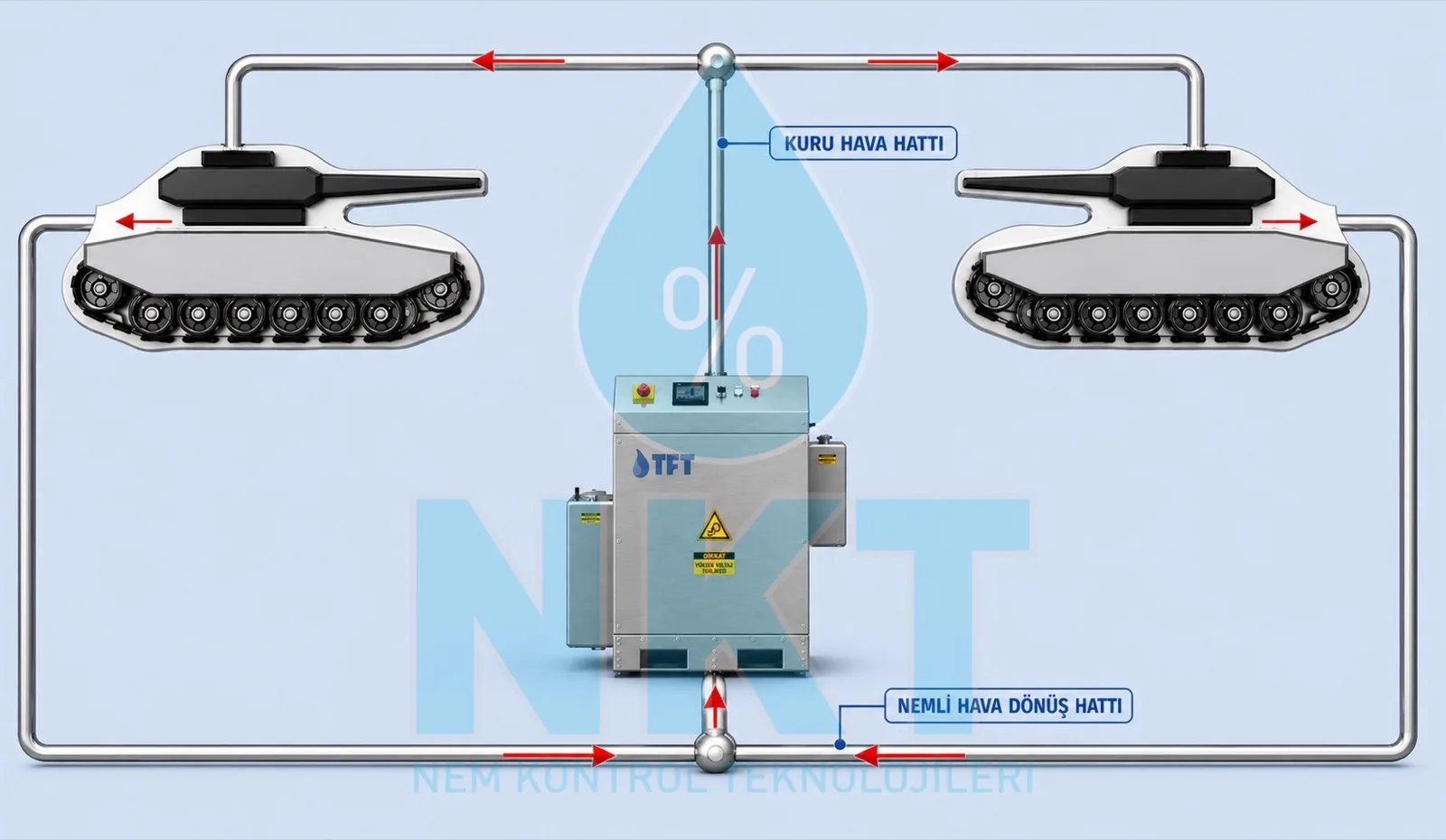
Powerpack assemblies (engines, transmissions, and final drives) are also vulnerable to humidity-related degradation during storage. Condensation forming on cylinder walls in non-running engines causes surface rust that scores bore surfaces on restart. Moisture in fuel systems promotes microbial growth and accelerates oxidation in diesel tanks. Transmission and differential housings sealed against water ingress can still accumulate internal moisture through temperature cycling, leading to corrosion on gear surfaces. A facility-wide dehumidifier solution addresses all of these risks simultaneously by maintaining a stable, dry atmospheric environment throughout the storage building.
Modern military ground vehicles carry increasingly dense electronic payloads, vehicle intercoms, tactical data network terminals, situational awareness displays, and electronic warfare systems. These embedded electronics require the same humidity protection as standalone electronic equipment. While some individual systems incorporate sealed enclosures or desiccant canisters for localized protection, these measures are no substitute for maintaining the overall storage environment at low relative humidity using a continuously operating industrial dehumidifier. A controlled storage atmosphere significantly improves first-start electronic system success rates when vehicles are taken out of storage.
Long-term vehicle storage programs, governed by NATO stock management principles and national defense reserve requirements, depend heavily on environmental protection to remain economically viable. Vehicles stored for years or decades without adequate humidity control require extensive and expensive rehabilitation before they can be returned to service, often including full electrical system rewiring, hydraulic replacement, and engine overhaul. Dehumidifiers integrated with automated humidity monitoring and remote alarm systems allow facility managers to maintain verifiable environmental records and respond immediately to any equipment fault, ensuring the integrity of long-term storage programs.
At NKT – Humidity Control Technologies, our engineering team designs and delivers industrial dehumidifier solutions for military ground vehicle storage facilities of all sizes, minimizing corrosion, optical damage, and electronic degradation while ensuring that armored and wheeled vehicle fleets remain ready for immediate deployment. For more information, please contact us through the form below.