Definition
The EU's safety directive (2014/34/EU) for equipment used in explosive atmospheres. All electrical and mechanical equipment operating in environments with dust, gas, or vapor (chemistry, pharma, flour mills, lithium battery dry rooms) must be ATEX-certified. Industrial dehumidifiers are produced in ATEX Zone 1/2/21/22 certified variants for such environments.
Detailed Explanation
The ATEX directive was issued in 1996 and updated in 2014 (2014/34/EU). Environments at risk of explosive atmospheres are divided into 6 zones:
GAS/VAPOR atmospheres: • Zone 0 — continuously explosive (e.g., inside tanks) • Zone 1 — occasionally explosive in normal operation (near process equipment) • Zone 2 — explosive only in abnormal conditions
DUST atmospheres: • Zone 20 — continuous dust cloud • Zone 21 — occasional dust in normal operation • Zone 22 — dust only in abnormal conditions
ATEX equipment categories: • Category 1 — for Zone 0/20 (highest safety) • Category 2 — for Zone 1/21 • Category 3 — for Zone 2/22
ATEX-compliant variants in dehumidifiers: • Anti-static fan and rotor — preventing static charge buildup • EX-proof motor (Ex e or Ex d certified) • EX-proof control panel (spark-isolated) • Grounding + bonding mandatory • Temperature limit T3 (200°C) or T4 (135°C) — based on gas ignition temperature
Lithium battery dry rooms are typically classified Zone 22 (lithium dust); equipment selection must be ATEX Cat 3 or Cat 2D.
Practical Example
An ATEX-compliant dehumidifier system for a lithium battery dry room:
Condition: lithium-metal anode process, dry room target –45°C dp, ATEX Zone 22 classification (lithium dust risk)
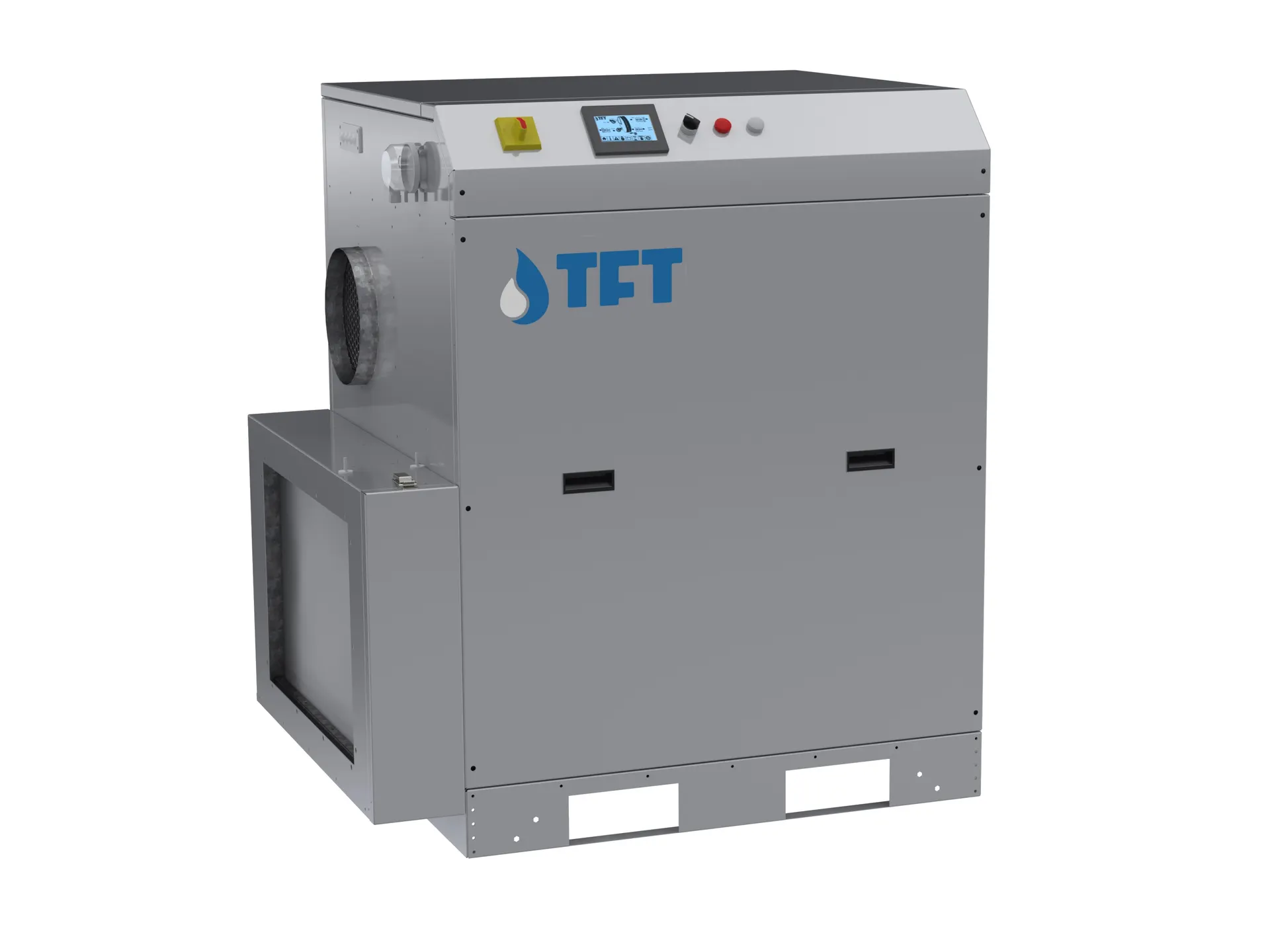
Solution: • Unit: TFT ADP6500 silica gel rotor — ATEX Cat 3D variant (Zone 22 compliant) • Antistatic components: rotor, fan, ductwork — all surfaces conductive-coated • Grounding: 4-point connection to plant ground bar • Motor: Ex tD A22 IP65 certified • Control panel: Ex-d certified, in a separate room (outside Zone 22) • Sensors: ATEX-approved (ATEX-certified humidity sensor series) • Communication: fiber optic (no electrical conduction)
Cost difference (vs standard variant): • CAPEX: +35% (€280K → €380K per unit) • OPEX: +5% (special maintenance requirements) • But: no alternative — standard unit means explosion risk + insurance + criminal liability
Additional installation requirements: • Ex-proof lighting • Antistatic wrist straps + conductive flooring (10⁴–10⁶ Ω/sq) • Continuous particulate + lithium concentration monitoring • Emergency ventilation system (lowers internal explosion risk) • Firefighting: special lithium-type (no water)
At NKT we offer special equipment + design + commissioning service with TFT Italy on ATEX projects.
Engineering Note
Five critical points for ATEX compliance:
1. Correct zone classification — incorrect zone choice (e.g., Zone 21 instead of Zone 22) explodes cost or creates safety risk. ATEX risk assessment must be done with an expert.
2. Equipment + installation + maintenance = holistic approach — buying ATEX equipment alone is not enough; correct installation, periodic inspection, and operator training are required. EN 60079-17 standard.
3. Grounding + bonding critical — static electricity sparks are the most common explosion cause. All metal surfaces grounded + bonded; resistance < 1 Ω.
4. Temperature class (T-class) — selected per application gas. T3 (200°C) sufficient for most; T4 (135°C) for hydrogen environments.
5. Audit trail + certification — every unit's Cindustrial humidity sensorX certificate must be filed; presented during occupational safety audits. Use of uncertified equipment = penalty + insurance cancellation.
At NKT, with our ATEX-expert team, we offer risk assessment + equipment selection + installation oversight + maintenance services for TFT Italy's special variant equipment.