Definition
A particulate air filter that captures 0.3-micron particles with at least 99.95% efficiency under the EN 1822 standard. Mandatory in ISO 14644 cleanrooms (ISO 5–7), pharmaceutical GMP, semiconductor manufacturing, and hospital HVAC. In industrial dehumidifiers, used as the final stage to capture micro-particulates that may come from the rotor.
Detailed Explanation
HEPA (High-Efficiency Particulate Air) filters are defined as Class H under EN 1822:
• H10: 85% efficiency at 0.3 µm • H11: 95% • H12: 99.5% • H13: 99.95% (cleanroom standard) • H14: 99.995% • U15-U17: ULPA (Ultra-Low Particulate Air) — for semiconductor
Filter media is glass microfiber or PTFE; an accordion-pleated mat mounted in an aluminum frame or polypropylene housing. The 0.3-µm size is chosen because it is the most-difficult-to-capture (MPPS - Most Penetrating Particle Size); smaller and larger particles are captured at higher efficiency (Brownian motion and impaction effects).
The HEPA stage in industrial dehumidifiers: • Mandatory in cleanroom applications (pharma, semiconductor) — captures micro-particulates (typically 0.5–2 µm) that may shed from the silica gel rotor • H13 sufficient for ISO 7; H14 + ULPA may be required for ISO 5 • F7+F9+H13 cascade is typical (pre-filter staging) • Differential pressure monitoring + alarm (ΔP > 250 Pa = clogged filter, replace)
Practical Example
Filter cascade for a lithium battery dry room HVAC + dehumidifier system:
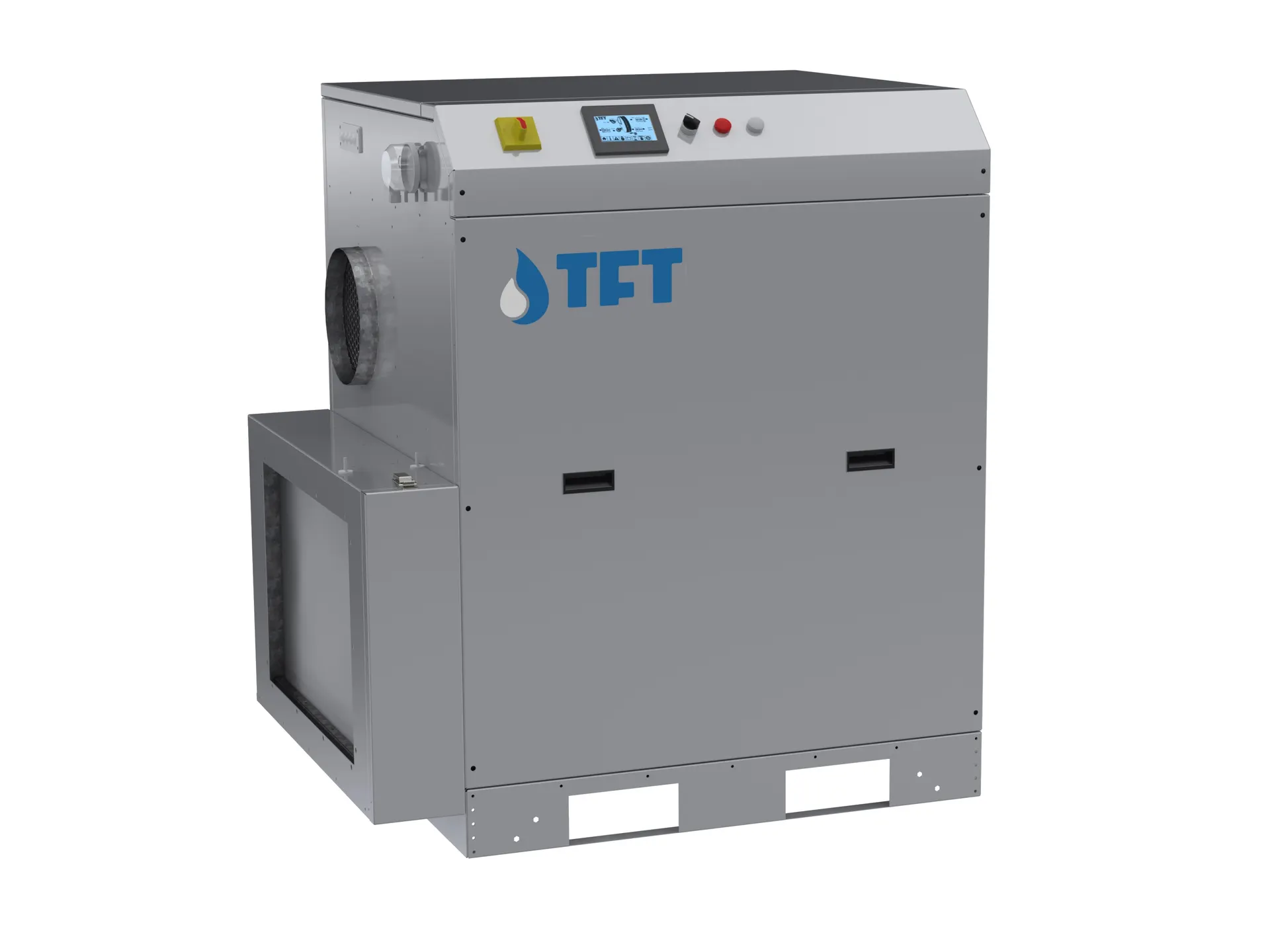
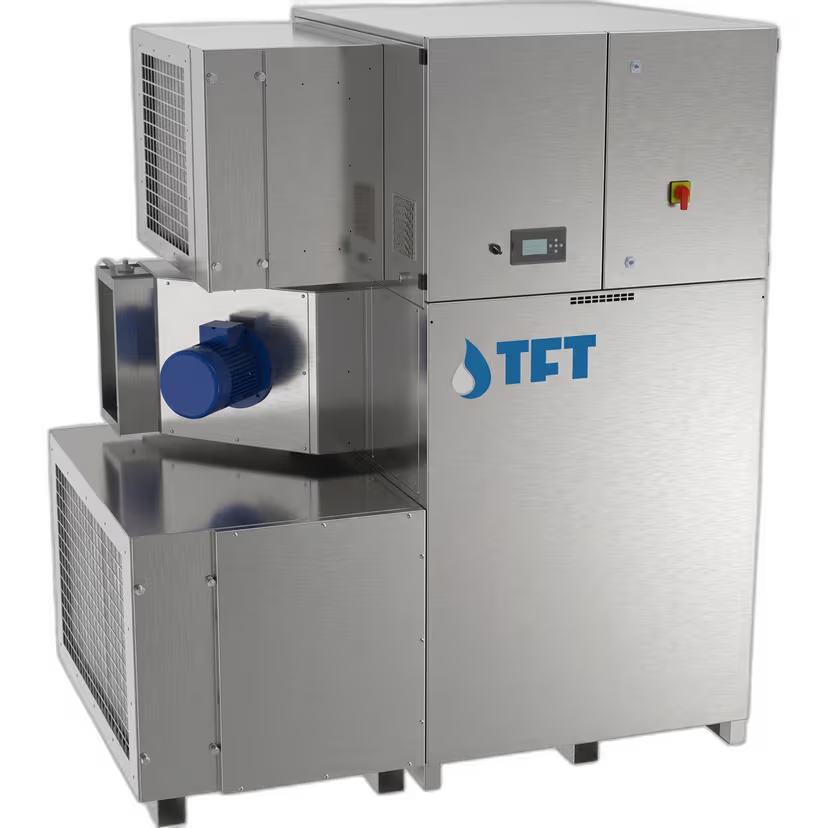
Dry room target: –45°C dp, ISO 7 cleanroom (≤ 352,000 particles/m³ at 0.5 µm) Main equipment: 2× TFT ADP6500 silica gel rotors, 6,500 m³/h air
Filter cascade (process airflow direction): 1. F7 pre-filter (EN 779) — large particles + dust; monthly replacement, €25 each 2. F9 mid-filter — medium particles + dust to protect F7 and H13; 6-monthly replacement, €80 each 3. H13 HEPA — final particulate protection; 24–36-month replacement, €350 each 4. (Optional) Activated carbon filter — VOC and organic vapor capture; 12-month replacement, €180 each
Reactivation airflow filter: 5. F7 (regeneration air inlet) — dust/particle protection; 6-month replacement, €25 each
Differential pressure sensors: • F7 inlet: alarm at ΔP > 200 Pa • F9 inlet: alarm at ΔP > 250 Pa • H13 outlet: alarm at ΔP > 300 Pa + integrity test every 6 months (with DOP test)
Annual filter cost: ~€700 per unit — a small line item, but neglecting it leads to cleanroom non-compliance + production downtime, a catastrophic outcome.
Engineering Note
Six important decisions in HEPA filtration design:
1. Filter class selection — do not over-specify; H14 costs 2× H13 and requires 30% more fan energy for capacity. H13 is sufficient for ISO 7; H14 only for ISO 5 and below. 2. Cascade structure — F7 + F9 + H13 trio extends H13 life by 5–7×. With only H13 installed, it clogs in 6 months instead of 5 years. 3. Differential pressure monitoring — manometer or pressure switch is standard; SCADA integration with trend charts simplifies maintenance planning. 4. Filter change techniques — bag-in/bag-out (BIBO) systems prevent contamination risk; mandatory for pharma and semiconductor; €2,500–€8,000 extra cost but protects operator + product. 5. Budget + sustainability — H-class filters are single-use; difficult to recycle. Renewable filter technologies (HEPA-replaceable cartridge) have advanced over the past 5 years, with 20% cost savings. 6. DOP / PAO test — H13 and above filters require integrity testing after installation and periodically (every 6 months or annually); for leak detection.