Definition
A feedback control algorithm that compensates deviation via proportional (P), integral (I), and derivative (D) components to continuously hold a setpoint value. In industrial dehumidifiers and humidifiers it is the standard control method for RH or dew-point setpoint tracking. A well-tuned PID loop holds the band to ±1% RH precision, prevents oscillation, and saves energy.
Detailed Explanation
The PID algorithm combines three mathematical components:
• P (Proportional): correction proportional to current deviation — large deviation → large correction • I (Integral): historical accumulation of deviation — small but persistent deviation eventually produces a large correction, driving steady-state error to zero • D (Derivative): rate of change of deviation — anticipates future deviation for early correction
In a humidity-control application: • P opens the humidifier capacity to 50% when RH measurement is 5% from setpoint • I slowly increases capacity if RH has been 1% low for 30 minutes • D reduces capacity early when RH is rising rapidly (prevents overshoot)
Good PID tuning is done via Ziegler-Nichols, Cohen-Coon, or manual trial methods. Modern PLCs include self-tuning algorithms; industrial PLC's PID_Compact block offers automatic tuning. A well-tuned PID: • Tracks setpoint within a ±1% RH band • Recovers from load changes in 2–5 minutes • Does not oscillate (oscillation = instability) • Minimizes energy consumption
PID Equation
u(t) = Kp × e(t) + Ki × ∫e(t) dt + Kd × de(t)/dt
u(t): control output (e.g., humidifier capacity 0–100%) e(t): error = setpoint − measurement Kp: proportional gain Ki: integral gain Kd: derivative gain t: time
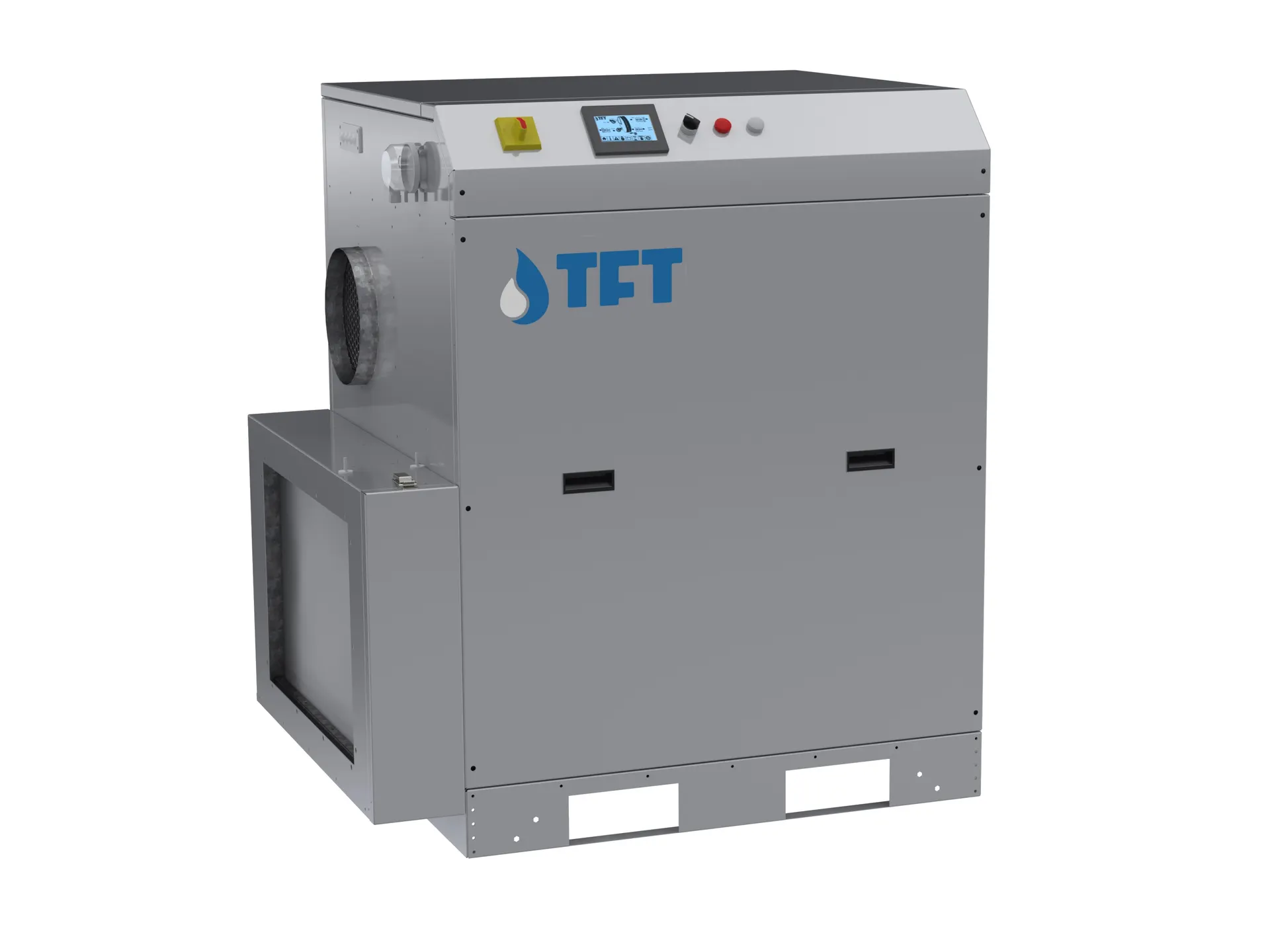
Typical tuning values for humidity control (TFT silica gel rotor): • Kp = 5–15 (%/°dp) • Ki = 0.05–0.2 (%/°dp/min) • Kd = 0.5–2 (%/°dp×min)
Note: too-high Kp = oscillation, too-low Kp = slow response. No Ki = persistent offset. Too-high Kd = noise amplification.
Practical Example
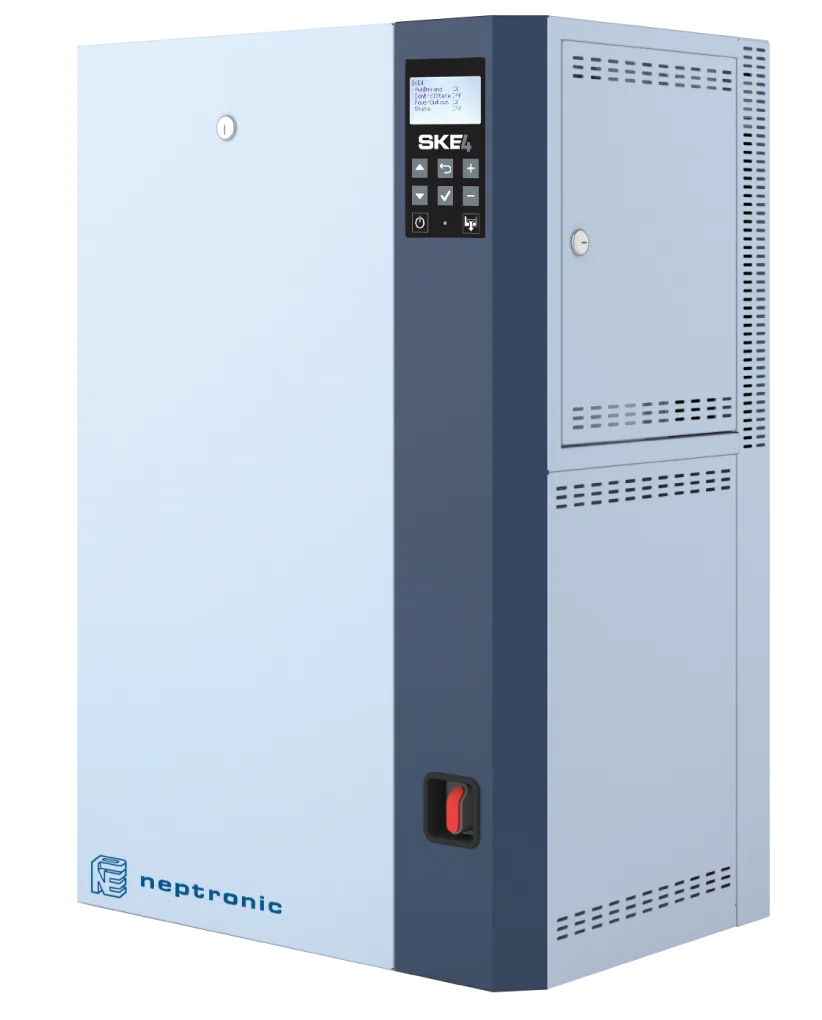
PID tuning example for a Neptronic SKE4 steam humidifier in a printing hall:
Condition: 800 m² printing hall, target RH 50 ± 3%, outdoor air 25% RH in winter (dry)
Initial: default PID (Kp=20, Ki=0.5, Kd=0.1) Result: 5–10% oscillation, on/off capacity cycling, energy waste, increased paper waste
Tuning procedure (modified Ziegler-Nichols): 1. Step test: manually set capacity 0% → 50%, measure RH response 2. Determine time constant (T) and lag (L): T=8 min, L=3 min 3. Suggested Kp=1.2×T/L=3.2; Ki=Kp/(2L)=0.53; Kd=Kp×L/2=4.8 4. Test with initial values, manual fine-tune
Final values: Kp=8, Ki=0.15, Kd=2 Result: • Stabilized within ±1.5% RH band • 4-minute recovery from load change • No oscillation, minimal on/off cycling • 22% lower energy consumption (vs prior on/off behavior) • Paper waste fell from 0.6% to 0.2%
Engineering Note
Five critical points in PID design:
1. Sensor placement — PID loop quality is strongly dependent on sensor location. The duct sensor and the room sensor have different response times; room sensor is preferred for PID but responds slower. 2. Sample rate — sensor reading at 1–30 s; too-fast sampling (< 1 s) is noise-sensitive, too-slow (> 60 s) reacts insufficiently. 3. Anti-windup — when the integral component saturates, control output blows up. Modern PLC PID blocks include anti-windup; manual control needs care. 4. Cascaded PID — temperature and humidity must be controlled separately. Controlling both with one PID creates interference; cascade (master-slave) PID gives the best result. 5. Adaptive PID — PID parameters should change based on load. Fuzzy logic or model-predictive control (MPC) is preferred in highly dynamic facilities; extra complexity but 15–25% better tracking.
Related Academy Articles
Related Products
NKT products related to this term