In humidity-control projects for hygienic zones, pharma cleanrooms or sensitive printing halls, one question almost always reaches the proposal table: "We will feed RO or deionized water, will the steam humidifier work with it?" The answer depends entirely on which device type is selected. RO (reverse-osmosis) water and deionized water (DI) have very low electrical conductivity; this property creates the sharpest divide between electrode humidifiers and resistive humidifiers. This guide explains why RO/DI feedwater affects the two technologies in fundamentally different ways, in which conditions each choice is the natural one, and how RO/DI sits in the water hardness/TDS/scale-formation balance.
What Are RO and DI Water?
RO and DI are both "purified water" but produced through different treatment technologies. For steam humidifiers, their common feature is the near-elimination of dissolved-ion load; which corresponds to very low electrical conductivity.
RO (Reverse-Osmosis) Water
An RO system pushes water under pressure (8–15 bar) through a semi-permeable membrane that removes dissolved salts, minerals and organic matter. A typical RO unit retains 95–99% of dissolved solids; outlet conductivity drops to 5–25 μS/cm. The system continuously splits the feed into concentrate (waste) and permeate (use); recovery is typically 50–75%.
Deionized (DI) Water
A DI system runs water through ion-exchange resins that swap dissolved cations (Ca²⁺, Mg²⁺, Na⁺) and anions (HCO₃⁻, Cl⁻, SO₄²⁻) with hydrogen and hydroxyl ions. The outlet is practically ion-free; conductivity falls to 0.5–5 μS/cm. DI is typically used as a second stage after RO; standalone DI is uneconomical because resin regeneration is frequent.
Mixed-Bed / EDI
EDI (Electrodeionization) is a continuously regenerated ion-exchange resin bed under an electrical field, downstream of RO. Outlet conductivity drops below 0.1 μS/cm; in pharma and semiconductor industry the standard combination is RO + EDI. Cost is higher but operation is continuous.
Figure 1: RO/DI Water, Low Conductivity and Two Humidifier Responses
Why RO/DI Water Is Used
Facilities choose RO or DI feedwater for humidification for several reasons. All of them share one purpose: eliminating the uncertainty introduced by water quality at the source. With low dissolved-ion load, the most common field problems, scale-formation rate, mineral aerosol carry-over, corrosion risk and shortened cylinder life, are largely zeroed out.
Hygienic / GMP Mandate
Pharma cleanrooms (cGMP, EU GMP Annex 1), hospital operating theatres (ASHRAE 170), food hygienic zones and semiconductor production lines treat "mineral-free steam" as an absolute requirement in most projects. Silica, alkalinity components and other dissolved salts in mains water carry over with steam and produce white-dust accumulation on HEPA filters, mineral spotting on product surfaces and audit non-conformance. RO pre-treatment removes these risks at the source.
Hard Mains / Well Water
When hardness exceeds 25 Fr° or well water is mandated, electrode cylinder life drops to 3 months and resistive chamber cleaning requires 3–4 interventions per year. RO pre-treatment cuts equipment maintenance cost by 5–10×; typical payback is 2–4 years.
Tight RH / Stability
In museums, archives, pharma stability cabinets and sensitive printing (wherever ±1–2% RH bands are mandated) water-quality drift directly translates into control-band drift. RO outlet conductivity stays practically constant year-round, so the control architecture preserves its consistency too.
Adiabatic / Atomisation Mandate
High-pressure atomisation and ultrasonic humidification systems cannot run without RO or DI water. Mineral-bearing water clogs nozzles within months; the emitted aerosol carries minerals into the space, causing HEPA fouling and surface spotting.
Why Conductivity Is Low
Electrical conductivity is directly proportional to dissolved-ion concentration. The pure H₂O molecule itself self-ionizes only weakly (pure water ≈ 0.055 μS/cm); virtually all measured conductivity comes from dissolved salts, minerals and organic matter.
An RO membrane or DI resin captures these dissolved ions, leaving the outlet water "electrically passive." Numerically:
| Water Source | Typical Conductivity | TDS | Hardness | Notes |
|---|---|---|---|---|
| Pure H₂O (theoretical) | 0.055 μS/cm | 0 ppm | 0 Fr° | Self-ionization of water molecules only. |
| EDI / Ultra-pure | < 0.1 μS/cm | < 0.1 ppm | 0 Fr° | Semiconductor industry standard (18.2 MΩ·cm). |
| DI (mixed-bed outlet) | 0.5–5 μS/cm | 0.3–3 ppm | < 0.1 Fr° | After ion-exchange resin. |
| RO permeate | 5–25 μS/cm | 3–15 ppm | < 1 Fr° | After single-stage RO. |
| City mains (Istanbul) | 250–500 μS/cm | 150–300 ppm | 10–18 Fr° | Typical mid-hard mains. |
| City mains (Central Anatolia) | 500–900 μS/cm | 300–550 ppm | 18–28 Fr° | Hard, scale-prone mains. |
| Hard well water | 800–1,500 μS/cm | 500–950 ppm | 25–40 Fr° | Mineral-rich, high calcium/magnesium. |
| Sea water | 40,000–55,000 μS/cm | 30,000+ ppm | > 100 Fr° | Not applicable to steam humidification. |
RO/DI water sits at the "purified" end of the scale; the electrode unit's working window starts at 125 μS/cm. RO/DI output therefore lies well below the minimum operating limit of an electrode system, physically, no current can flow.
Why Electrode Systems Struggle With RO
An electrode steam humidifier turns water itself into part of the electrical circuit. A 200–400 V AC voltage applied between two stainless-steel electrodes drives current through dissolved ions; the resistance of water generates Joule heating and the water boils. In this architecture, current = voltage / resistance, as conductivity falls, current falls and steam output falls with it.
When RO/DI outlet conductivity sits at 5–25 μS/cm, an electrode unit behaves in the following ways:
- Does not run or runs marginally: Until the device reaches the manufacturer-specified minimum of 125 μS/cm, steam output stays at 5–20% of nominal capacity.
- Automatic salt dosing: Some models address this by metering a controlled salt solution into the cylinder; which eliminates the entire RO/DI benefit and adds operational complexity.
- Excessive water use: To produce steam at low conductivity, the device raises water level; current still cannot flow; the chamber repeatedly fills and drains; annual water consumption climbs 2–3×.
- Control-band drift: Temperature, pressure and feedwater-conductivity swings make cylinder current unpredictable; even a ±5% RH band is hard to hold.
Why Resistive Is More Compatible
A resistive steam humidifier's working principle is the opposite: do not put water in the electrical circuit, just heat it. Incoloy 800 immersion resistive elements inside an AISI 304 stainless chamber are driven to a 110–130°C surface temperature, and the surrounding water boils. In this architecture, water is passive (its conductivity can be 0 or 5,000 μS/cm) steam output does not change.
So when a resistive unit is fed RO/DI water, it operates at nominal capacity. In addition, low ion load yields the following gains:
- Scale-formation rate near zero: Post-RO hardness ≈ 5 mg/L (under 1 Fr°); scale generation is 14× lower than 14 Fr° mains water.
- Chamber-cleaning period extends: A chamber that needs 1–2 cleanings per year on mains water drops to one cleaning every 2–3 years on RO/DI.
- Mineral-free steam: Pure H₂O vapour, HEPA fouling, surface spotting and hygiene-class breaches are zeroed.
- Stable control band: Year-round constant water quality keeps capacity and the ±1% RH control band consistent across seasons.
- Low blowdown: Slow mineral build-up in the chamber means lower blowdown frequency; annual water use drops 30–50%.
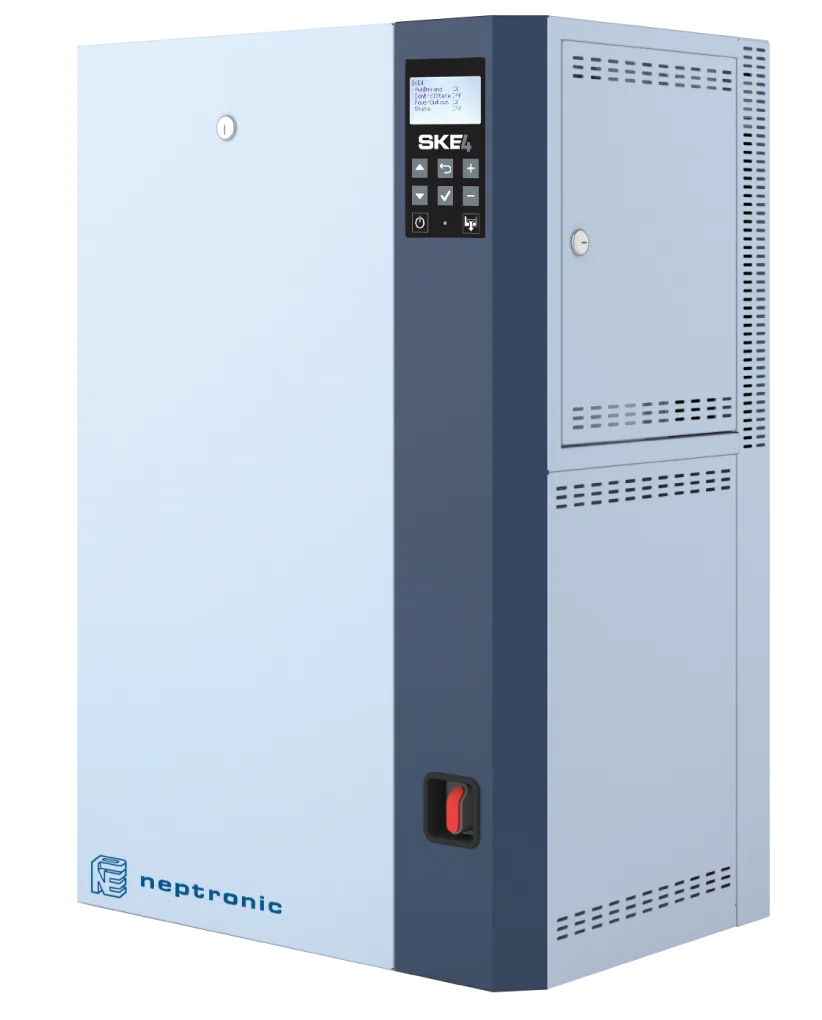
The Neptronic SKE4 resistive steam humidifier is naturally positioned in the NKT catalogue for RO/DI feed. AISI 304 stainless-steel permanent evaporation chamber, Incoloy 800 immersion resistive elements and a tool-free maintenance cover simplify the equipment-selection step for RO/DI projects. A ±1% RH control band, BACnet/Modbus communication and outdoor-cabinet option make SKE4 the first recommendation for hygienic facilities.
Is Low Conductivity Always an Advantage?
RO/DI feed delivers a clear advantage for resistive systems, but the "RO on every project" approach is not automatically correct. Systems designed without accounting for the secondary effects of low-conductivity water encounter different problems:
1. Corrosion Tendency Rises
Purified water (DI in particular) is chemically "aggressive", its dissolving capacity is high and it tends to pull ions from metal surfaces. Low-grade stainless steel or copper pipework wears over time. Solution: AISI 304/316 stainless or PVDF/PEX piping; Incoloy 800 for the resistive element (SKE4 standard).
2. Sterilization Requirement on Adiabatic Systems
RO/DI water is not microbiologically sterile; on the contrary, low ion content creates a favourable environment for certain bacteria and biofilm. Atomisation systems require RO feed + UV sterilization + tank circulation. Steam systems get sterilization for free at 100°C+; this concern applies only to adiabatic.
3. RO Reject (Concentrate) Management
For every 100 L of permeate, an RO system discharges 30–100 L of reject (concentrate) water. This affects the water bill and environmental sustainability. Modern RO units reach 75% recovery (3:1); legacy units sit at 50% (1:1). As facility scale grows, high-recovery RO selection becomes important.
4. Investment + Maintenance Cost
An RO system needs €8,000–25,000 investment + €800–2,500 annual membrane/filter maintenance. For small-scale office or commercial buildings this investment can be disproportionate; an electrode unit + typical mains water can remain the right choice.
Maintenance With RO Water
With RO/DI feed + a resistive unit, the maintenance profile changes meaningfully compared to mains-fed operation:
| Maintenance Item | Mains Water (350 μS/cm) | RO/DI Water (10 μS/cm) | Notes |
|---|---|---|---|
| Chamber cleaning period | 1–2 times per year | Once every 2–3 years | RO water keeps mineral deposit minimal. |
| Cleaning duration | 30–45 min | 15–25 min | Less deposit = faster cleaning. |
| Blowdown frequency | Hourly / 4-hour cycle | Daily / weekly cycle | Concentration limit reached more slowly. |
| Annual water consumption | 100% reference | 55–70% | Lower blowdown reduces total use. |
| Resistive element life | 7–10 years (soft water) | 10–15 years | Without scale, thermal cycling is gentler. |
| Steam manifold cleaning | Once every 2–3 years | Once every 5+ years | Mineral dust accumulation near zero. |
| RO pretreatment maintenance | None | Annual membrane/filter swap | Additional maintenance line item, planned annual work package. |
Overall: the humidifier-side maintenance load drops 2–3× with an RO/DI system; on the RO side a new annual membrane/filter swap is introduced. Net effect: facility-wide maintenance planning becomes more predictable and surprise failures fall to a minimum.
Joint Treatment + Humidifier Selection
Water-treatment system and humidifier type are not two independent decisions, they are a matched pair. Reverse sequencing produces the most common field problems: "we bought an electrode unit, then added RO and it stopped working," or "we bought an atomisation humidifier, fed it mains water, the nozzles clogged in 2 months."
Figure 2: Water Treatment + Humidifier Selection Decision Flow
The correct sequence is: (1) clarify facility application and precision requirement → (2) take water sample analysis → (3) decide pretreatment → (4) select device type → (5) plan integration and commissioning. This sequence resolves the electrode/resistive conflict at the project stage rather than dragging it into site operations.
Field Examples
Representative decisions from the NKT project portfolio:
Example 1: Pharma Production Facility (Sterile Line)
Profile: cGMP Annex 1, ±2% RH band, HEPA filtration, mineral-free steam mandatory. Mains water 380 μS/cm, 14 Fr°. Decision: RO + DI (EDI) + Neptronic SKE4 resistive. Reason: hygiene standard, tight RH and mineral-free steam mandate. RO/DI disables electrode; resistive is the only choice.
Example 2: Office Building (Comfort)
Profile: winter comfort band 35–55% RH, ±5% acceptable, no hygiene requirement. Istanbul mains 320 μS/cm, 11 Fr°. Decision: typical mains + Neptronic SKS4 steam-to-steam or SKE4 resistive. RO investment is unnecessary; typical mains is sufficient.
Example 3: Museum Display Hall
Profile: ISO 11799 conservation standard, 50% ± 3% RH, seasonal stability mandatory. Location: Ankara, mains water 580 μS/cm, 22 Fr° (hard). Decision: RO + Neptronic SKE4 resistive. Hard water + ±3% band + long-term stability → RO pretreatment with resistive.
Example 4: Textile Production Hall
Profile: 1,000 kg/h humidification load, 70–80% RH target, adiabatic cooling desired. Bursa mains water 410 μS/cm, 16 Fr°. Decision: RO + Neptronic SKH atomisation system. Atomisation nozzles require RO; steam system would have consumed 8× more electricity.
Example 5: Logistics Warehouse (Comfort)
Profile: warehouse personnel comfort + static-electricity reduction, 40–55% RH, no hygiene requirement. Location: Izmir, mains 290 μS/cm, 12 Fr°. Decision: typical mains + Neptronic SKE4 or SKS4. RO investment not required; typical mains is in the resistive's comfortable band.
NKT Approach
NKT, Humidity Control Technologies takes water analysis ahead of equipment selection in the proposal phase. As Neptronic's official Turkish distributor, RO pretreatment + steam humidifier are delivered as a single integrated solution. The proposal package includes:
- Site water sample analysis: Seven-parameter certified-lab report (pH, hardness, conductivity, TDS, alkalinity, chloride, silica).
- Typical-band measurement: Two-season measurements (Turkish water conductivity can swing 30–50% over the year).
- RO pretreatment sizing: Annual water use + waste recovery (50% vs 75%) + membrane life assessment.
- Device-type mapping: Profile + application → SKE4 (resistive), SKS4 (steam-to-steam), SKD (steam injection) or SKH (atomisation).
- 10-year TCO analysis: RO investment + humidifier + maintenance + waste + energy line items, transparent comparison.
- Commissioning + 6-month performance validation: Trend log analysis, parameter fine-tuning, calibration verification.
This approach treats the RO and humidifier decisions not as two separate purchase items but as a single engineering whole; it resolves retrofit problems of the "RO arrived, the device stopped working" kind during the project phase.
RO and deionized water are purified streams with minimal dissolved-ion load; their electrical conductivity sits in the 0.5–25 μS/cm band. This property creates the sharpest technology divide between electrode humidifiers and resistive humidifiers: electrode units do not run on RO/DI in practice, while resistive units deliver their ideal performance with this feed.
For hygienic facilities, tight RH bands, hard mains water or atomisation systems, RO pretreatment + resistive steam humidifier (Neptronic SKE4) is the natural combination. This selection extends equipment life, minimises maintenance load and meets hygiene standards. For offices, commercial buildings, warehouses or mid-comfort applications, typical mains water + resistive or steam-to-steam (SKS4) remains economically sufficient.
For the correct decision, water treatment and humidifier selection must be made together, they are not independent decisions. As Neptronic's official Turkish distributor, the NKT engineering team delivers the water analysis → RO pretreatment → equipment selection → commissioning → periodic maintenance chain end to end.