In industrial humidification projects, one of the two most frequently debated questions at the proposal stage is "what water should feed the humidifier?" Whether the facility should run on direct mains water, softened or pre-filtered water, or invest in a full RO (reverse-osmosis) water system affects decisions from device architecture to plumbing, maintenance workload and long-term operating cost. The answer does not fall under a single heading; it emerges from weighing three dimensions together: which device technology was selected, what is the real profile of the supply water and what is the hygiene-stability requirement of the application. This guide compares mains water, softened water, deionized (DI) water and RO water for humidification, clarifies how electrode, resistive and adiabatic technologies behave with each water type, lists the required water-analysis parameters and presents a water-selection matrix together with decision steps.
Why Water Matters So Much
In humidification systems, water is not just a raw material; it is a design parameter that directly determines device performance, maintenance workload, hygiene profile and long-term cost. Calcium, magnesium, bicarbonate, chloride, silica, organics and microbial load in mains water affect five areas regardless of device type:
- Scale-formation rate: Water hardness (Fr°) and temperature move together; in steam systems that take water to the boiling point, scale accumulation accelerates at high hardness.
- Cylinder / chamber life: The cylinder of an electrode device or the chamber cleaning cycle of a resistive device is directly bound to hardness.
- Steam quality: Steam generated from mineral-bearing water can carry mineral aerosol into the duct and the space; HEPA fouling and surface spotting may follow.
- Hygiene load: In adiabatic systems, stagnant water + lukewarm temperature increase Legionella and biofilm risk; water quality and water conditioning manage this risk.
- Electrical conductivity: An electrode device runs entirely on conductivity; it does not work with water outside its operating window.
These five areas must be evaluated together when deciding the right water type at the proposal stage. In some applications a "cheap-looking" mains-water choice can become more expensive than an RO system within 5 years due to cylinder-replacement frequency.
What Is Mains Water and What Are the Ranges?
Mains water is the water supplied by the municipality or facility network, compliant with drinking-water standards but considered "raw" for humidification. The minerals, organics and disinfection residues (chlorine, chloramine) it contains vary significantly from region to region. Typical ranges across Türkiye:
| Region / Water Profile | Conductivity (μS/cm) | Hardness (Fr°) | TDS (ppm) | Profile |
|---|---|---|---|---|
| Istanbul (Terkos, Ömerli, Elmalı) | 250-450 | 10-18 | 150-280 | Mid-hardness mains |
| Izmir, Aegean coast | 300-600 | 15-22 | 200-350 | Mid-hardness mains |
| Ankara, Central Anatolia | 500-900 | 18-30 | 300-550 | Hard mains |
| Konya, Karaman, Aksaray | 700-1,200 | 25-40 | 450-750 | Very hard mains |
| Antalya, Mediterranean | 400-800 | 15-28 | 250-500 | Mid-hard, scale-prone |
| Well water (Anatolia) | 800-2,000 | 30-60 | 500-1,200 | High mineral, low chlorine |
Within mains water, pH, alkalinity, chloride and silica values also affect device selection. In water with silica above 30 ppm, silica scale (a glass-like crust) forms in steam systems; chloride above 250 ppm starts pitting corrosion risk on stainless steel (AISI 304). These parameters show annual variability; a 12-month current water analysis is the primary reference at the proposal stage.
What Is RO Water and How Is It Produced?
RO (Reverse Osmosis) water is produced by forcing water under pressure through a semi-permeable membrane that removes most of the mineral content. A typical RO system at 8-15 bar retains 95-99% of dissolved salts, a significant portion of organics and most of the microbial load. The outlet conductivity drops to 5-25 μS/cm; hardness becomes practically zero (<1 Fr°) and TDS sits at 3-15 ppm.
An RO system continuously splits the feed water into two streams: permeate (purified, usable water) and concentrate / reject (concentrated waste, sent to drain). In industrial RO systems the recovery rate is typically 50-75%; meaning 1.3-2 m³ of feed water is consumed per 1 m³ of permeate. This water loss is a sustainability constraint for RO investment; however, in industrial applications equipment life and hygiene benefits usually compensate.
In applications where RO alone is not enough, the RO + EDI (Electrodeionization) combination is used. EDI passes the RO outlet through a continuously regenerated ion-exchange resin bed under an electrical field; outlet conductivity drops below 0.1 μS/cm. In pharma cleanrooms and semiconductor manufacturing requiring ultra-pure water, RO + EDI is the standard.
The Difference Between DI and RO Water
In humidification literature RO and DI are often mentioned together; from the humidifier's perspective both behave similarly (low conductivity, low hardness), yet their production methods and cost profiles differ.
| Property | RO (Reverse Osmosis) | DI (Deionized) |
|---|---|---|
| Operating principle | Semi-permeable membrane + pressure | Ion-exchange resin |
| Typical conductivity | 5-25 μS/cm | 0.5-5 μS/cm |
| First investment | Mid (fixed industrial equipment | Low) small unit + resin |
| Operating cost | Low (membrane replaced every 2-5 years | High) frequent resin regeneration (acid + base) |
| Waste generation | 25-50% reject water | Regeneration chemical waste |
| Hygiene assurance | High (membrane retains bacteria | High (with post-mixed-bed filtration) |
| Industrial use | Standard) economical at large capacity | Usually second stage after RO |
Standalone DI is not economical for industrial humidification; resin regeneration uses acid and base chemicals at short intervals, and operational burden arises with waste. In practice the standard approach is to install RO as the primary purification and, if needed, follow with EDI or mixed-bed DI to reach the ultra-pure band. From a humidifier perspective the RO outlet (5-25 μS/cm) is clean enough; further purification is only needed in pharma GMP, semiconductor and laboratory applications.
Electrode Device + Water Type Relationship
An electrode humidifier turns water into part of the electrical circuit; current flows through dissolved ions in the water, and electrical conductivity directly determines device capacity. This architecture has the strictest water-type requirements.
Electrode devices typically operate in the 125-1,250 μS/cm conductivity window. Below this window current is insufficient and the device cannot produce steam; above this window excess current, foaming and cylinder damage occur. The behaviour matrix:
| Water Type | Conductivity | Electrode Behaviour |
|---|---|---|
| RO water | 5-25 μS/cm | Does not run, below window, no current |
| DI water | 0.5-5 μS/cm | Does not run (below window, no current |
| Softened | 300-800 μS/cm | Marginal) high foaming risk |
| Mains (mid) | 400-700 μS/cm | Compatible (12-18 month cylinder life |
| Mains (hard) | 700-1,200 μS/cm | Compatible) 6-10 month cylinder life |
| Very hard / well | > 1,200 μS/cm | Exceeds window, foaming, rapid cylinder damage |
The "right water" for an electrode system is mid-hardness mains. Electrode devices can therefore be a typical choice in regions with mid-hardness regional water like Istanbul or Izmir; in hard mains cylinder life shortens significantly; on very soft / RO water they do not run at all. In projects where RO exists or is planned, the electrode architecture is structurally wrong, in these projects the resistive (SKE4) is the natural choice.
Resistive Device + Water Type Relationship
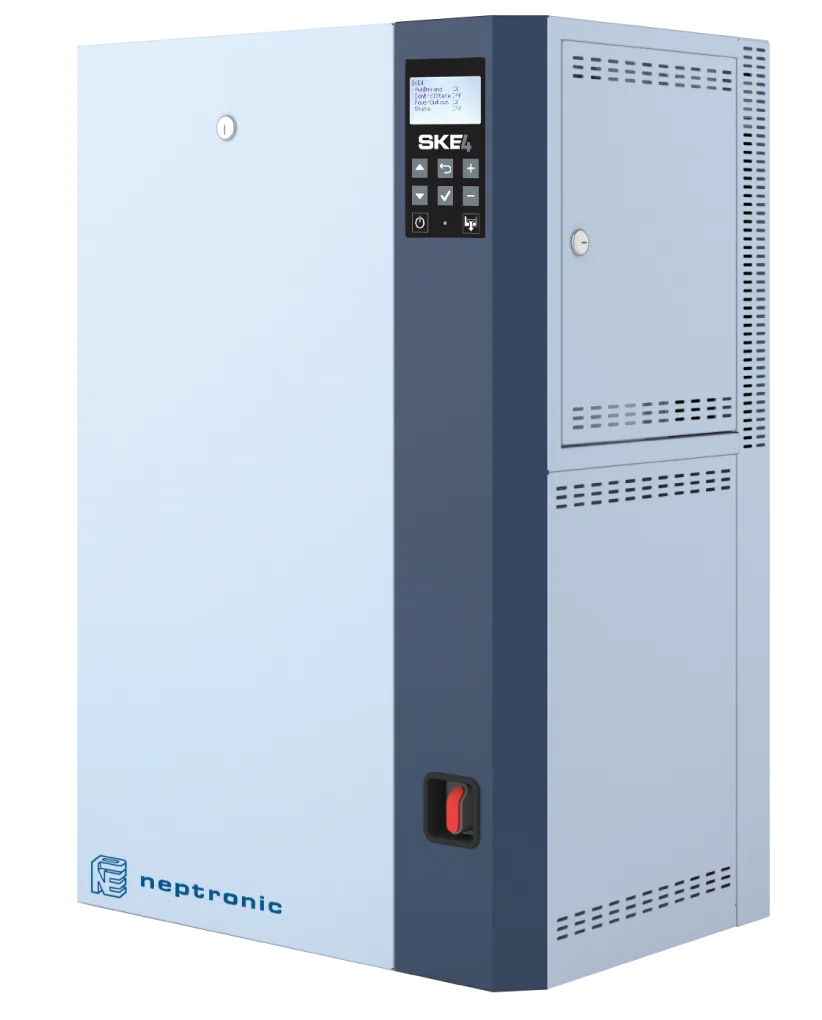
A resistive steam humidifier keeps water completely isolated from the electrical circuit. Steam is produced by Incoloy 800 (or similar high-nickel-alloy) immersion resistive elements inside a stainless-steel evaporation chamber. Water is a passive heat sink; whether its conductivity is 0 or 5,000 μS/cm the device operates at nominal capacity. This makes resistive systems compatible with all water types.
| Water Type | Hardness | Resistive (SKE4) Behaviour |
|---|---|---|
| RO / DI | < 1 Fr° | Ideal (chamber cleaning every 2-3 years |
| Softened | 0-2 Fr° | Ideal) annual single cleaning |
| Mains (mid) | 10-25 Fr° | Compatible (annual single cleaning |
| Mains (hard) | 25-45 Fr° | Compatible) annual 2 cleanings |
| Very hard / well | > 45 Fr° | Compatible (RO pre-treatment recommended), chamber cleaning every 3 months |
The "right water" for a resistive system is RO or softened water; in this combination the chamber cleaning cycle drops to once a year or less, element life extends to 5-7 years, and steam quality becomes mineral-free. It works with mains water too; only maintenance frequency rises with hardness.
In hygienic / GMP applications (hospital, pharma, food ripening, museum, ICH stability), the SKE4 + RO combination has become the practical standard in the Turkish market. The advantages: (1) scale formation is practically zero, (2) steam is mineral-free, (3) the ±1% RH control band is preserved, (4) the 10-year TCO is net positive.
Adiabatic Device + Water Type Relationship
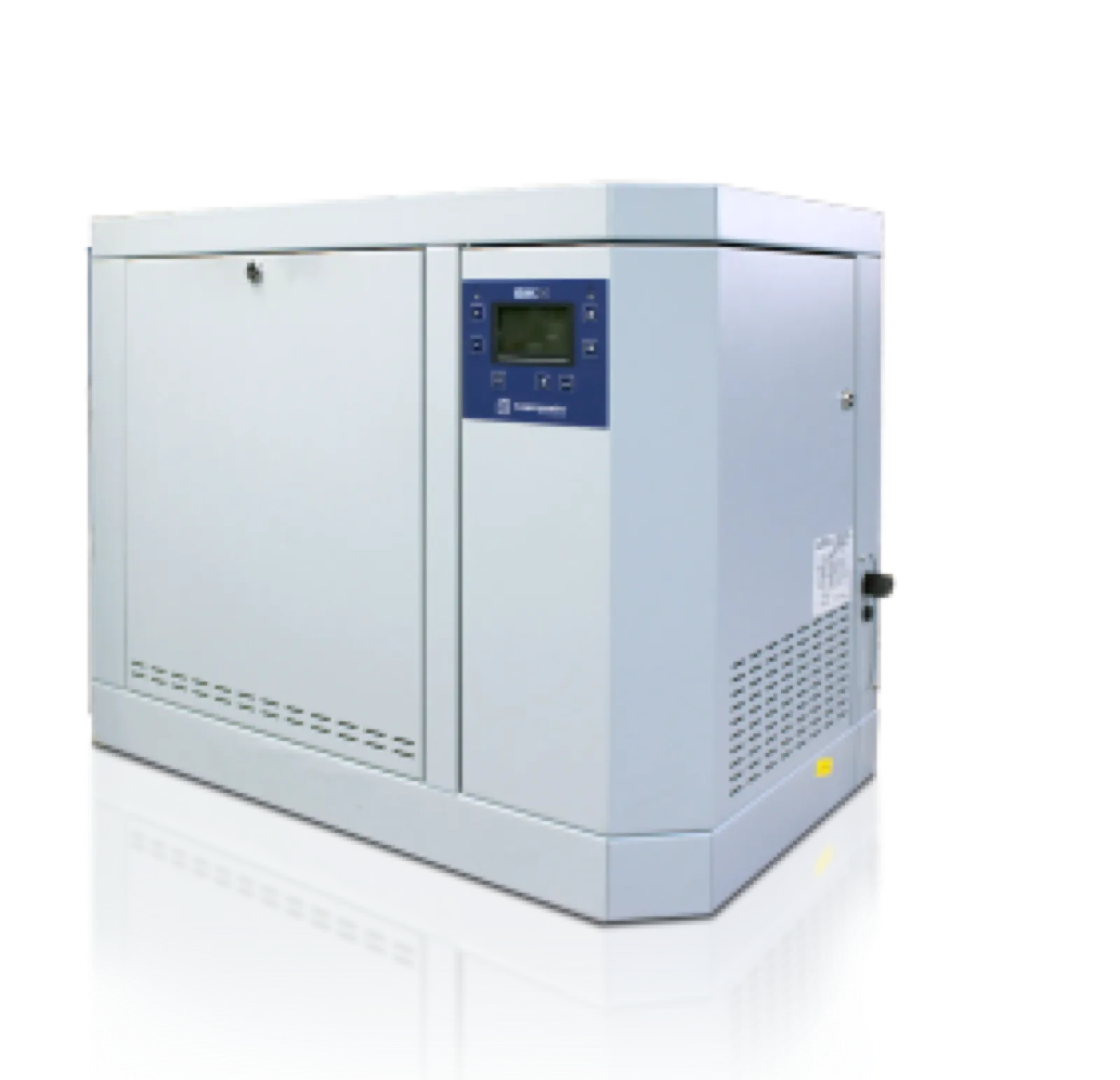
Adiabatic humidification, particularly high-pressure atomisation (SKH) and evaporative (SKV / SKVF), behaves completely differently from steam systems regarding water. These systems do not boil water; they convert it to micro droplets or evaporate it across a pad. As a result, water minerals stay in the airborne droplet, not in the steam.
Consequently, RO or DI water is practically mandatory for adiabatic systems. Effects when run on mains water:
- Nozzle clogging: Minerals in mains water crust on the internal surfaces of high-pressure atomisation nozzles; within weeks the nozzle aperture narrows and the spray pattern degrades.
- Mineral aerosol: Droplets atomised from mains water release minerals into the space; HEPA fouling, white-dust accumulation on surfaces and contamination of sensitive electronics occur.
- Pad scaling: Mineral accumulation on the surface of evaporative pads (cellulose or ceramic) impairs permeability; efficiency drops and pad life shrinks from 5-7 years to 1-2 years.
- Hygiene risk: The chlorine / organics balance in mains water in a lukewarm tank facilitates Legionella and biofilm growth.
For these reasons, Neptronic SKH high-pressure atomisation systems require RO or DI feed water; the holistic system performance is guaranteed only under this condition. SKV and SKVF evaporative / cooler devices can run on mains water, but in a hygienic food application RO + UV disinfection is recommended.
Is RO Always the Right Solution?
"The purest water is always the best water" is a widespread but incorrect assumption. RO investment is mandatory and the natural choice in some applications, while in others its economic logic weakens or it produces unexpected technical issues.
- Water loss: Recovery rate 50-75%; every 1 m³ of RO water needs 1.3-2 m³ of feed water. The waste water goes to the municipal drain.
- First investment: An industrial RO system is an additional 8,000-25,000 EUR investment.
- Corrosion tendency: Purified water is chemically "aggressive"; low-grade stainless steel or copper pipework can corrode.
- Bacteriological stagnancy risk: A long-stagnant RO tank can develop biofilm; UV disinfection or loop circulation is required.
Practical scenarios where RO is not always right:
- Small-capacity electrode systems: If there is an existing electrode device on site, installing RO will disable the device. Here, water softening + careful water-analysis tracking is more sensible than RO.
- Mains water is already soft: In a mid-hardness mains like Istanbul (10-15 Fr°), a compact small resistive system needs only one chamber cleaning per year; economic payback is weak.
- Small-volume (sub-10 kg/h) single devices: RO installation and maintenance cost is disproportionate for a small device; at this capacity mains water + good water-analysis tracking can suffice.
- Site space constraint: A large RO system can fall outside feasibility for projects with limited machine-room space.
When Mains Water Suffices
In some applications mains water is an acceptable solution without additional water-conditioning investment. To decide, the real feed-water profile, the device type and application sensitivity must be evaluated together.
| Application | Device | Mid-Hard Mains Sufficient? | Note |
|---|---|---|---|
| Office, commercial plaza | Resistive SKE4 small | Yes | One chamber cleaning per year is enough |
| Hotel, multi-residential | Electrode / Resistive | Yes (ideal for electrode) | Cylinder cycle 12-18 months |
| Small data centre | Resistive SKE4 | Yes | RO is optional |
| Hospital corridor | Resistive SKE4 | Limited (RO recommended | Mineral steam fouls HEPA |
| Operating theatre, cGMP | Resistive SKE4 / SKS4 | No) RO mandatory | Hygiene requires mineral-free |
| Museum, archive | Resistive SKE4 | Limited, RO recommended | Surface-spotting risk |
| Print room, press | Resistive SKE4 | Yes (hardness < 20 Fr°) | RO extends cylinder/element life |
| Textile weaving | SKH atomisation | No, RO mandatory | Nozzles clog |
| Cold storage | SKV evaporative | Yes (with UV) | UV disinfection recommended for hygiene |
The practical rule from the table: for steam systems mid-hardness mains is acceptable in most applications; for adiabatic systems RO/DI is practically mandatory; for hygienic applications (hospital, pharma, food) RO is the natural choice.
Required Water-Analysis Values
For the correct water-type decision in a humidification project, the feed water must be measured for at least the following six parameters. This analysis is performed in an accredited laboratory and updated across 12 months to capture seasonal variability.
| Parameter | Typical Range | Humidifier Impact | Limit |
|---|---|---|---|
| Conductivity (μS/cm) | 5 – 1,500 | Electrode window; no impact on resistive | Electrode: 125-1,250 |
| Hardness (Fr°) | 0 – 60 | Scale formation; cylinder/chamber life | Steam: < 25 recommended |
| TDS (ppm) | 3 – 1,000 | Overall mineral load; drain frequency | Adiabatic: < 20 mandatory |
| Chloride (mg/L) | 10 – 300 | AISI 304 stainless pitting corrosion | AISI 304: < 250 |
| Silica (mg/L) | 1 – 30 | Silica scale in steam systems | Steam: < 30 |
| pH | 6.5 – 8.5 | Corrosion balance; biological activity | All systems: 6.5-8.5 |
| Alkalinity (mg CaCO3/L) | 50 – 400 | Scale-forming tendency | Steam: < 200 recommended |
When the water-analysis report is shared with NKT project engineering at the proposal stage, the engineering team sizes the water type, the device technology and (if needed) the pre-treatment strategy together. A single water-analysis number alone does not yield a conclusion; all parameters are evaluated together.
High hardness or high production rate directly raises maintenance frequency.
Water-Type vs Technology Selection Matrix
The following 5×4 matrix summarises the compatibility of five water types with four core device technologies. This is the reference framework NKT project engineering shares with customers at the proposal stage.
| Water Type | Electrode | Resistive (SKE4) | SKS4 Steam-to-Steam | Adiabatic (SKH/SKV/SKVF) |
|---|---|---|---|---|
| RO Water 5-25 μS/cm | INCOMPATIBLE, does not run | IDEAL, minimal maintenance | IDEAL, clean steam | IDEAL, nozzle/pad protected |
| DI Water 0.5-5 μS/cm | INCOMPATIBLE, does not run | IDEAL, minimal maintenance | IDEAL, clean steam | IDEAL, ultra-pure aerosol |
| Softened 300-800 μS/cm, <2 Fr° | Marginal, foaming risk | Compatible, annual single cleaning | Compatible | Limited, TDS still present |
| Mains (Mid) 400-700 μS/cm, 10-25 Fr° | IDEAL, cylinder 12-18 months | Compatible, annual single cleaning | Limited, RO pre-treatment recommended | INCOMPATIBLE, nozzles clog |
| Hard Mains / Well >1,200 μS/cm, >30 Fr° | INCOMPATIBLE, exceeds window | Compatible (RO recommended) | RO mandatory | INCOMPATIBLE, RO mandatory |
Figure 1: Compatibility Map of Water Type and Device Architecture
Figure 2: Water-Type Decision Flow: Which Water for Which Project?
NKT / Neptronic Approach
NKT Humidity Control Technologies, as Neptronic's official Turkish distributor, drives the water-type vs device-technology vs hygiene-requirement triangle for humidification projects with field analysis, water-analysis reports and TCO modelling. The correct water-type decision is taken before equipment selection; even the right equipment will not meet performance targets if commissioned on the wrong water type.
In the NKT project flow, the water-type decision proceeds in steps: (1) A 12-month water-analysis report is requested from the facility. (2) The target application hygiene requirement is defined. (3) Candidate device technologies are matched. (4) If RO investment is required, sizing and TCO modelling are presented. (5) Annual water-analysis tracking is planned post-commissioning.
Portfolio water-type compatibility summary:
- SKE4 (Resistive), Compatible with all water types; ideal with RO/DI, compatible with softened and mid-mains, runs with hard mains (annual 2 cleanings).
- SKS4 (Steam-to-Steam), RO or DI feed recommended; the secondary chamber for clean-steam production requires hygienic water.
- SKH (High-Pressure Atomisation), RO or DI mandatory; nozzles clog quickly on mains water.
- SKV (Evaporative Humidifier), Can run on mains water; in hygienic food applications RO + UV is recommended.
- SKVF (Evaporative Cooler), Runs on mains; softened water is recommended to extend pad life.
- SKD (Direct Steam Injection + Distribution), Independent of the steam-generating device; compatible with clean-steam supply.
Closing Assessment
There is no single correct answer to "RO water or mains water"; the answer emerges from weighing three dimensions together: the selected device technology, the real profile of the supply water and the hygiene / stability requirement of the application. Resistive steam systems can run on all feedwaters independent of water type; here, the RO-vs-mains choice is a cost and maintenance optimisation decision. Electrode systems depend on the conductivity window and cannot run on RO; if RO arrives at the site, the electrode device drops out of service. For adiabatic systems (atomisation, evaporative) RO or DI is practically mandatory; otherwise nozzle clogging, mineral aerosol, pad scaling and hygiene issues arise.
The correct water-type decision begins with three questions: (1) Which device technology was selected? (2) What are the conductivity, hardness, chloride, silica and TDS values of the supply water? (3) What is the application's hygiene / GMP requirement? Combining these three with a water-analysis report and TCO modelling clarifies the right water-type-to-device match. The NKT engineering approach decides water type before equipment selection; the right water type is an engineering input that determines first and foremost the 10-year performance of the equipment.