In electrode steam humidifiers, the cylinder is a single-use plastic consumable that is replaced every 6-18 months at the unit's nominal capacity. In some facilities it lasts up to 24 months; in others it drops to 4-5 months. Two facilities with the same device, the same capacity and the same shift pattern can see cylinder life vary by a factor of three. This article reviews which parameters drive cylinder life, why it is hard to predict, and how the structural uncertainty can be removed, via the resistive alternative.
What Does the Cylinder Do?
In electrode steam humidifiers, the cylinder is the plastic body that contains the electrodes and the water. Two or three stainless-steel electrodes are mounted inside it; mains voltage (typically 380V three-phase) is applied to the electrodes, and the water completes the circuit between them. Current flows through the dissolved salts in the water by ionic conduction; Joule heating (P = I²R) boils the water and steam exits the top of the cylinder. The amount of steam produced is directly proportional to the active conductive water volume, in other words, to the water level and the ion density in the water.
The cylinder body is moulded from a high-temperature polymer (typically polypropylene or PPS). By design it is single-use: the layer of scale and mineral deposits that forms on the electrode surface eventually coats it completely; current flow into the water drops and the unit falls below its rated capacity. At that point the cylinder is removed, discarded and replaced. The electrode inside is thrown away with the plastic body, so the replacement is not a single wear part but almost the entire steam-generation module.
This architecture keeps initial cost low (the complexity of the device is pushed into the cylinder) but transfers a structural consumable cost into the operating phase. The NKT catalogue does not include an electrode model; this article is provided so that the technology can be understood independently and the right alternative recommended.
Why Cylinder Life Is Not Constant
It is hard to express cylinder life with a single number, because life depends simultaneously on the chemistry of the water and the usage profile of the device. Manufacturers typically state a wide range like "6-18 months under typical conditions", and even that range loses validity outside specific conditions. Two side-by-side units in the same facility can show different lives if the shift/load profiles differ.
Six core factors drive cylinder life: (1) the water's electrical conductivity, (2) water hardness and scaling tendency, (3) TDS and dissolved solids, (4) drain frequency and drain volume, (5) foaming tendency (silicates, organics), and (6) usage intensity (hours/day and modulation profile). These factors are discussed in sequence below; the final sections position life-extension strategies and the resistive alternative.
Figure 1. Mineral Build-up Inside an Electrode Cylinder Over Time
How Conductivity Affects Cylinder Life
An electrode cylinder operates within a specific conductivity window (typically 125-1,250 µS/cm). The window is defined by the manufacturer based on architectural design. Below the window, current is insufficient and the unit cannot generate steam; above it, current rises sharply, driving over-production, foaming, overflow and rapid scale deposition on the electrodes.
The relationship between conductivity and cylinder life is U-shaped: very low conductivity (< 125 µS/cm) prevents operation; within the optimum band (300-700 µS/cm), cylinders typically last 12-18 months. At high conductivity (> 1,000 µS/cm) the high mineral density coats the electrodes quickly and cylinder life drops to 6-10 months, in some cases down to 4-5 months. The figure below shows this relationship graphically.
Figure 2. Water Conductivity × Cylinder Life Relationship (Electrode)
In the central Anatolian cities of Türkiye (Konya, Kayseri, Sivas, Ankara), mains water is typically in the 700-1,200 µS/cm range with hardness in the 25-45 °fH band. In these waters, electrode cylinder life often sits at 6-10 months. In coastal Marmara and Aegean cities the 400-700 µS/cm range is common, and cylinders typically last 12-15 months.
Hardness and Scaling
Water hardness is the total content of calcium (Ca²⁺) and magnesium (Mg²⁺) ions in water; in Türkiye it is typically measured in French degrees (°fH). 1 °fH = 10 mg/L CaCO₃ equivalent. Hardness affects cylinder life through two distinct paths.
The first is scaling: as water heats to 100 °C, the solubility of dissolved calcium carbonate (CaCO₃) drops; in the high-temperature region directly at the electrode surface, the minerals precipitate as solid deposit. Over time this deposit forms an insulating layer between electrode and water; current flow into the water drops and a higher water level is needed to maintain the same capacity. The second is conductivity rise: hardness simultaneously increases conductivity; in very hard waters the conductivity creeps toward the upper end of the 1,250 µS/cm window and triggers over-current and foaming.
| Hardness Class | °fH | Conductivity (≈ µS/cm) | Typical Cylinder Life |
|---|---|---|---|
| Soft | 0 – 7 | 200 – 400 | 14 – 18 months |
| Slightly hard | 7 – 14 | 400 – 600 | 12 – 16 months |
| Moderately hard | 14 – 22 | 600 – 800 | 10 – 14 months |
| Hard | 22 – 32 | 800 – 1,000 | 8 – 12 months |
| Very hard | > 32 | 1,000 – 1,500 | 5 – 8 months |
TDS and Dissolved Solids
TDS (Total Dissolved Solids) is the total weight of all dissolved inorganic and organic components in water; expressed in mg/L. In addition to all hardness components, it includes other dissolved salts such as sodium, chloride, sulphate, silica and nitrate. Therefore two waters with the same hardness can have different TDS values.
In an electrode cylinder, TDS jointly drives water conductivity and the rate of deposition on the electrode surface. As water boils in the cylinder, TDS concentrates by the same fraction as the evaporated water, eventually the dissolved solids reach saturation and precipitate. This concentration cannot be controlled without draining; drain frequency is covered in the next section.
Without draining, TDS concentrates indefinitely → silica precipitation, foaming and uncontrolled current.
In waters with high silica content (some well waters, geothermal-influenced sources), silica deposits form a deposit that is harder and more tightly adherent than ordinary scale. In these waters cylinder life shortens faster than predicted, and cleaning the plastic cylinder is not feasible (silica deposits are hard to dissolve even with chemical acid).
Drain Frequency and Cylinder Life
Electrode units periodically drain automatically: they discharge a portion of the concentrated water to the drain and refresh with fresh water. This keeps TDS and hardness concentration inside the cylinder under control. Drain frequency is normally set automatically by the unit's firmware; in models with manual adjustment, it is calibrated to the facility water.
Very infrequent draining increases concentration and quickly "tires" the cylinder; very frequent draining increases water consumption and reduces energy efficiency (cold water is heated after each drain). The optimum frequency is a joint function of conductivity, hardness and usage intensity. Some design optimisations that aim to minimise drain volume can shorten cylinder life; aggressive draining in the other direction increases water consumption. In practice facilities iterate to find this balance based on water/energy costs.
Why Does Foaming Occur?
Foaming is the formation of a bubble layer on the water surface. In an electrode cylinder, foaming occurs when organic compounds, silicates, phosphates or certain water-softening/treatment chemicals in the water alter surface tension at high temperature. The chain reaction is: (1) the level sensor inside the cylinder reads the foam layer as water, (2) the real water level drops, (3) current becomes unstable, (4) part of the electrode is exposed to air and erodes rapidly, (5) electrode and cylinder life shortens dramatically.
To prevent foaming, some manufacturers implement software algorithms such as Anti-Foam Energy Conservation; the system performs a rapid drain when foaming is detected and recalibrates the level. However, if the foaming trigger sits in the water source (wrong treatment chemical, high silicates), the algorithm does not offer a permanent fix.
Wrong Water Treatment
Wrong water-treatment selection is among the most damaging structural errors for cylinder life. Three common treatment choices and their consequences for electrode units:
- Reverse osmosis (RO) water: Drops conductivity well below the band (5-25 µS/cm). The electrode unit will not run, RO water is the wrong feed for electrode systems.
- Deionised (DI) water: Same issue as RO, conductivity is insufficient and the unit does not operate.
- Sodium-based softener: Lowers hardness but sodium salts remain dissolved. Conductivity is usually preserved (in the 300-800 µS/cm band); this is an appropriate treatment. In some sodium-rich waters, however, foaming tendency may rise.
For this reason, when investing in a new electrode unit, water treatment must be decided together with equipment selection. If a facility already has an RO system, an electrode unit is the wrong choice; the resistive (SKE4) is preferred directly. This is one of the costliest design mistakes to undo later.
Usage Intensity and Operating Profile
Cylinder life is consumed not by elapsed hours but by total steam produced (kg steam). A 24/7 facility burns through cylinders much faster than a single-shift facility. A 24/7 profile at nominal capacity versus an averaged 40%-load profile across the day can differ in cylinder life by a factor of 2-3.
Modulation profile matters as well: a continuously on/off control algorithm (e.g. a wide-deadband thermostat) creates thermal shock and level fluctuations inside the cylinder; these foster micro-cracks and mineral nucleation sites on the electrode surface. Units with continuous PID modulation deliver longer cylinder life on this axis. In NKT proposals the facility's real daily steam-consumption profile (in annual kg) is extracted and the cylinder-swap period is forecast precisely.
| Operating Profile | Annual Steam (kg) | Typical Cylinder Life | Annual Swaps |
|---|---|---|---|
| Office / commercial, 8/5 shift | 2,000 – 4,000 | 15 – 18 months | 0.7 – 0.8 cyl/year |
| Hospital corridor, 24/7 low load | 5,000 – 10,000 | 10 – 14 months | 0.9 – 1.2 cyl/year |
| Print / production, 16/6 shift | 10,000 – 25,000 | 8 – 12 months | 1.0 – 1.5 cyl/year |
| Continuous production 24/7 | 30,000 – 80,000 | 4 – 8 months | 1.5 – 3 cyl/year |
Cylinder Consumable Cost
Cylinder consumable cost can be at least as large a line item in 10-year TCO as the initial purchase price. For a typical mid-capacity (45 kg/h) electrode unit the cost of one cylinder is in the 400-900 € range; if a hard-water facility requires 1.5-3 cylinder swaps per year, the 10-year cylinder line reaches 6,000-27,000 €.
This is a substantial fraction of the device's initial purchase price. Each cylinder swap also adds 1-2 hours of maintenance labour, warehouse logistics and plastic-waste handling costs. For facilities with sustainability reporting, 5-10 kg of plastic waste a year may sound small, but aggregated across the facility together with similar line items it reaches a material volume.
Extending Cylinder Life
There is a structural limit to extending electrode cylinder life; the architecture itself constrains the period to the 6-18 month window. To approach the upper bound of that window, six operating practices help:
- Water-treatment calibration: Sodium-based softener set to keep conductivity in the 300-700 µS/cm band. RO/DI is not appropriate; it will not run.
- Periodic water analysis: Water analysis at least every 6 months, conductivity, hardness, TDS, chloride, silica, alkalinity. Seasonal variations are accounted for.
- Drain-frequency optimisation: The manufacturer's factory setting may be too aggressive or too infrequent for the facility water; calibration is performed during the first 3 months.
- PID modulation instead of on/off: Choose units capable of modulation; avoid wide-deadband thermostat control.
- Parallel units instead of continuous overload: Running a single large unit at 95% of nominal capacity is harder on the cylinder than running two mid units in parallel.
- Regular visual inspection: Every 3 months, inspect the cylinder electrical connections, drain line and level sensor; catch foaming or mineral precipitation early.
Even with all of these practices, the cylinder remains a single-use consumable. The structural fix is to change the architecture.
Resistive Alternative
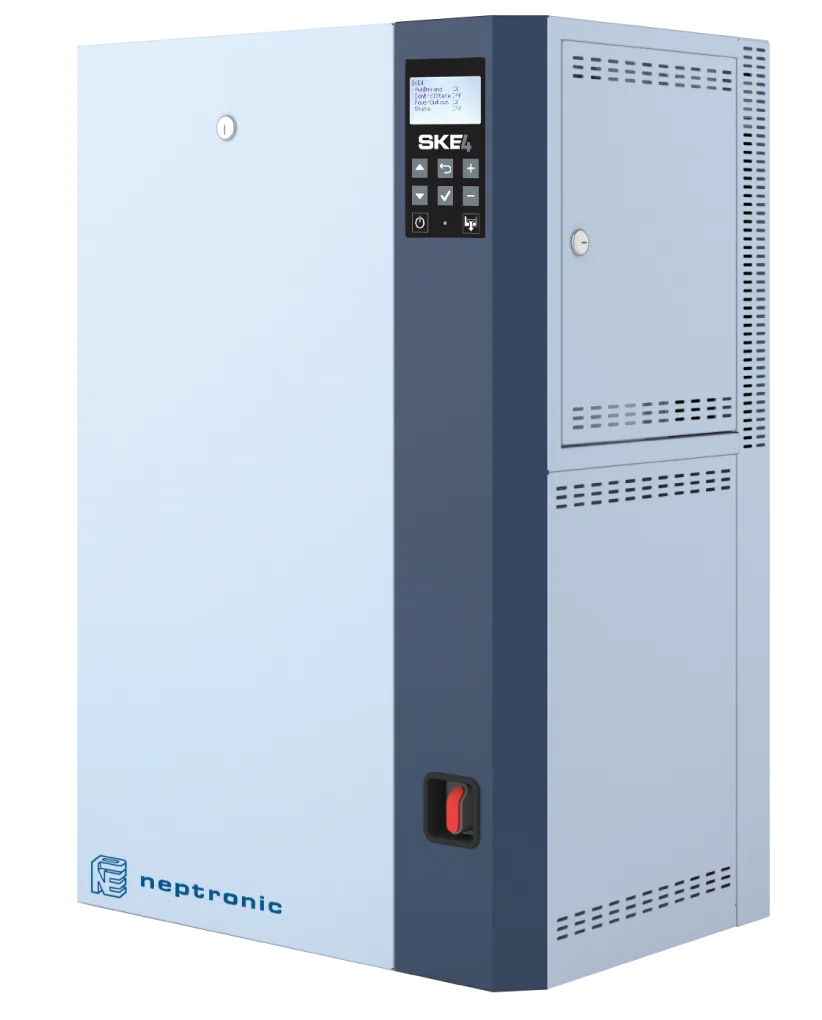
The structural fix for cylinder consumable cost, drain-water loss and plastic-waste problems is to switch to a resistive steam humidifier architecture. In a resistive unit there is no cylinder; steam generation takes place in a permanent stainless-steel evaporation chamber where Incoloy heating elements are immersed in the water. Water is not part of the electrical circuit; conductivity, hardness and TDS do not affect operation.
Instead of a consumable, the stainless chamber is cleaned tool-free 1-2 times per year (with RO feed, even this cleaning cycle is largely eliminated). The typical heating-element life is 5-7 years; replacement is a planned maintenance activity rather than a yearly consumable expense. Plastic waste production is zero.
| Dimension | Electrode (cylinder) | Resistive (SKE4) |
|---|---|---|
| Consumable | Plastic cylinder (6-18 months) | None (permanent stainless chamber) |
| Element / cylinder life | 0.7 – 3 cyl/year | ≈ 5-7 years element life |
| Water-quality dependence | Conductivity window required | None (every water type works |
| RO/DI feed | Does not run | Ideal) minimal maintenance |
| Plastic waste | 3-10 kg/year | Zero |
| Control band | ±5% RH (typical) | ±1% RH |
| 10-year consumable cost (mid-capacity) | 5,000 – 27,000 € | 500 – 2,500 € (element + cleaning only) |
NKT Approach
The NKT Nem Kontrol Teknolojileri portfolio does not include an electrode unit; the structural consumable-cost, water-quality dependence and plastic-waste issues are considered engineering-solvable, and the steam portfolio is built on Neptronic SKE4 resistive, SKS4 steam-to-steam, SKG4 gas-fired and SKD direct injection families.
In the NKT proposal process the facility's (a) water-analysis report, (b) existing/planned treatment system, (c) expected annual steam consumption, (d) required RH control band and (e) hygiene/sterility requirements are evaluated; the right technology is matched and the 10-year TCO is laid out clearly. In most cases the resistive solution (SKE4) overtakes the electrode alternative on total cost within the first 3-5 years; where the maths favours other architectures, alternatives (SKS4 with facility steam, SKG4 with natural gas) are evaluated.