

Fish drying is one of the oldest food preservation techniques in human history and continues to grow in importance at an industrial scale today. Traditional open-air drying methods were inherently dependent on weather conditions, subject to seasonal limitations, and produced inconsistent product quality. In modern indoor drying facilities, dehumidifier systems enable precise control of temperature, relative humidity, and air circulation parameters, making uninterrupted, repeatable production possible every day of the year. Indoor drying also delivers a significant cost advantage by reducing labor costs by up to 80%.
Industrial fish drying typically consists of two stages. During the primary drying stage, fish are dried at 18–25°C and 20–50% relative humidity with an air velocity of approximately 3 m/s for 24 to 40 hours, reducing the water content to 50–55%. In the secondary drying stage, a longer drying cycle at 22–26°C and 20–50% relative humidity brings the product to its final target moisture level. In both stages, it is critically important that the ambient temperature never exceeds 30°C; above this threshold, the fish flesh becomes brittle, a cooking effect occurs, and product quality is irreversibly compromised. Drying rooms equipped with a dehumidifier continuously monitor these sensitive parameters, ensuring the process remains within safe limits at all times.
In fish drying, each species and size has its own unique drying curve. Thin-fleshed small fish and thick, fatty large fish release moisture at different rates, which means drying room conditions must be individually optimized for each product type. Drying methods can employ either cabinet-type systems or conveyor belt continuous-line systems. After drying, products are classified by quality grade, typically sorted into 3 to 5 different grades, ranging from premium food-grade products to animal feed. The accuracy of this classification is directly linked to how consistently humidity was controlled throughout the drying process.
Silica gel rotor dehumidifiers are the preferred technology for fish drying facilities. These units maintain high moisture removal capacity even at the low temperatures where compressor-based systems lose efficiency, making them the ideal solution for fish drying processes that operate at drying temperatures of 18–26°C. The rotor technology also supports homogeneous air distribution within the drying chamber, ensuring uniform drying at every point and preventing unwanted surface crust formation on the fish.
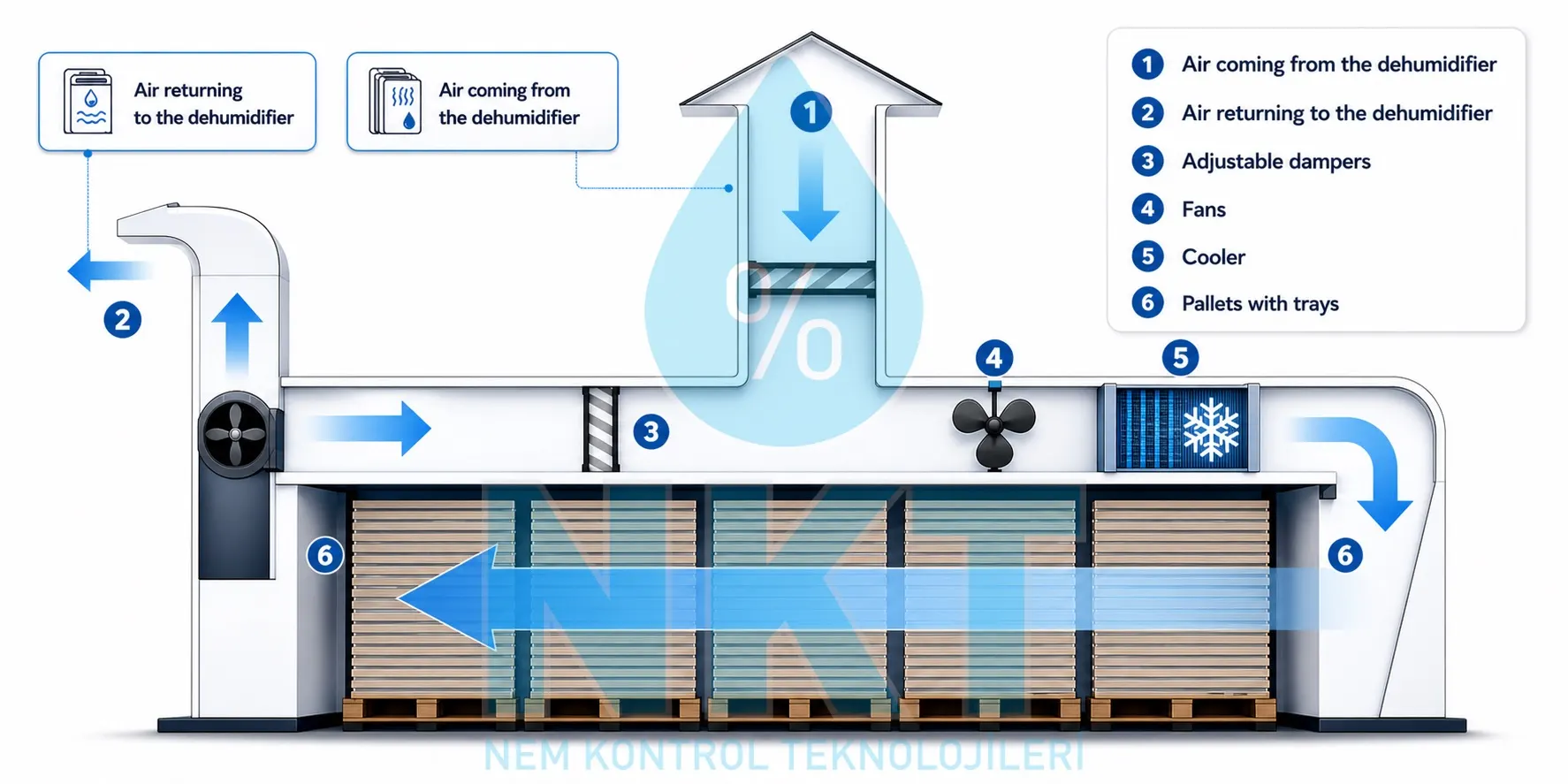
Proper design of the drying chamber and accurate calculation of the dehumidifier capacity are decisive factors for energy efficiency and product quality. The chamber volume, daily fish processing volume, initial moisture content, and target final moisture value are evaluated together to determine the total moisture load. A dehumidifier selected without accounting for these parameters will either be undersized (prolonging drying times) or oversized, leading to energy waste. A system dimensioned with correct engineering calculations both optimizes energy costs and preserves the nutritional value of the fish, enabling premium-quality production.
The hygiene dimension of dehumidifier-assisted indoor drying is equally critical. A controlled low-humidity environment suppresses the growth of bacteria, mold, and fungi, ensuring compliance with food safety standards and significantly extending the product's shelf life. The risks of dust, insect contamination, and environmental pollution associated with open-air drying are completely eliminated. A final moisture check before packaging guarantees that the product meets market specifications.
At NKT – Humidity Control Technologies, our expert engineering team designs industrial dehumidifier solutions tailored to the primary and secondary drying stages of your fish drying facilities, supporting you throughout the entire process from capacity calculations to system integration. For more information, please contact us through the form below.