

Powdered food and industrial raw materials (flour, starch, granulated sugar, powdered sugar, milk powder, cocoa, spice blends, and powdered PVC plastic) interact directly with ambient moisture at every stage of the production process. The defining characteristic shared by these products is their extremely rapid moisture absorption from ambient air due to their large surface area. Once moisture absorption begins, powder particles adhere to one another, flowability is lost, and production line blockages, weighing errors, and quality deviations become inevitable. A dehumidifier is the fundamental engineering approach that resolves these problems at their source in powder food manufacturing.
In starch production, the dried powder passes through multiple conveyors, screens, and hoppers before reaching the packaging station. If ambient humidity is not controlled at any point along this transfer route, the starch develops a sticky surface film that causes it to adhere to conveyor belts, screen surfaces, and hopper walls. The adhering product creates both material loss and line stoppages due to the periodic cleaning required. An industrial dehumidifier system covering the entire production area maintains relative humidity below the target value throughout the transfer route, completely eliminating this adhesion cycle.
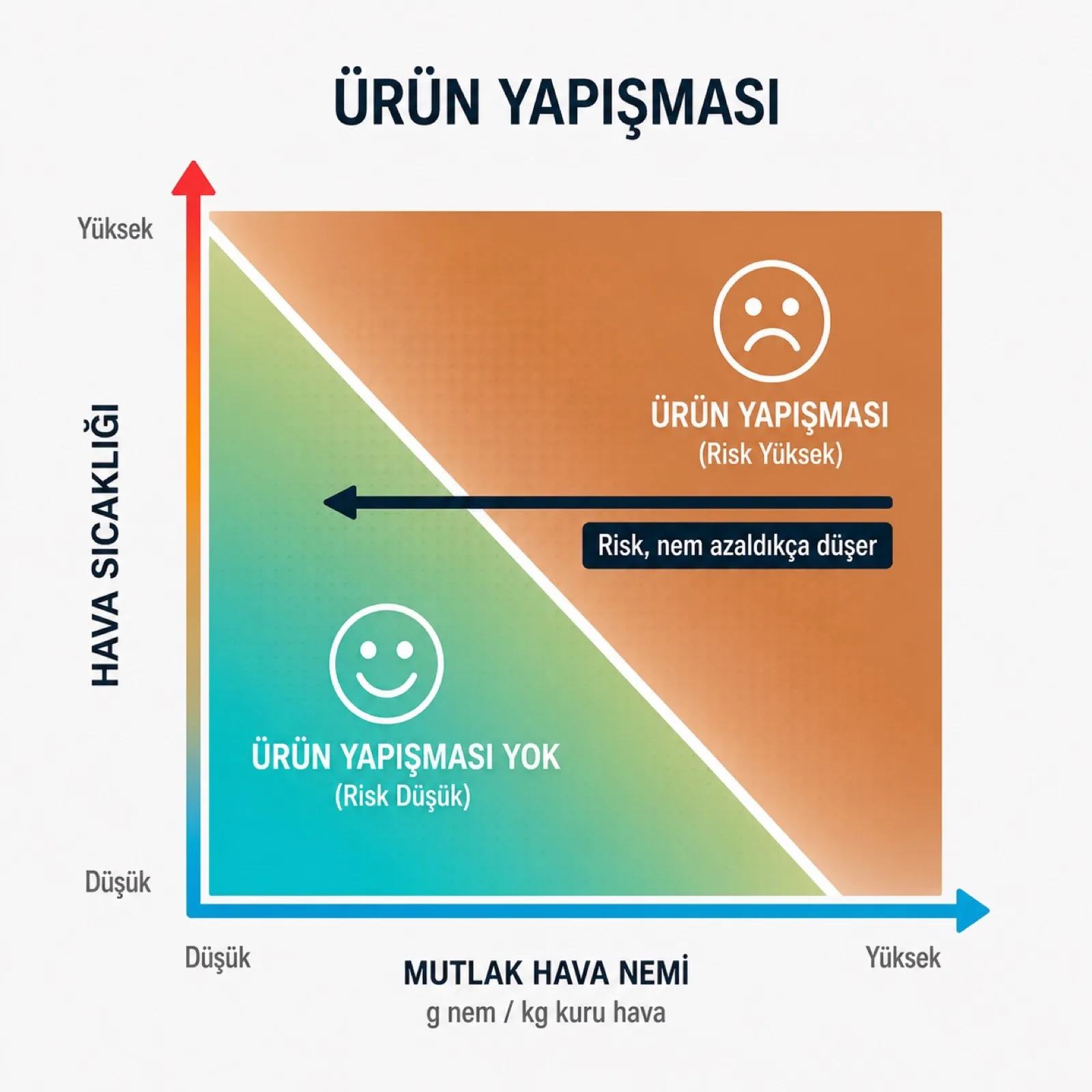
In flour milling and flour-based mix production, humidity control carries dual importance for both product quality and facility safety. In high-humidity environments, flour clumps, screen efficiency drops, and packaging machine dosing accuracy deteriorates. Beyond this, fine flour particles suspended in the air can create an explosive atmosphere at certain concentrations; in humid conditions these particles adhere to each other, forming unexpectedly large clusters that make dust explosion risk harder to predict. Ambient humidity maintained by a dehumidifier both preserves the product's free-flow characteristics and contributes to keeping dust concentration within safe limits.
Powdered sugar and icing sugar production is among the most moisture-sensitive areas in food manufacturing. Icing sugar produced by grinding crystalline sugar has an exponentially increased surface area due to its reduced particle size and absorbs ambient moisture almost instantly. This causes the icing sugar to harden, form solid blocks, and create flow problems on the packaging line. In Turkish cotton candy (saray helvası) production, icing sugar is kneaded with flour and fat to create a delicate layered structure; the success of this process depends on the moisture content of the raw materials remaining constant. A dehumidifier system operating in the raw material preparation and mixing areas ensures that icing sugar and flour enter the process without absorbing moisture, securing the texture and taste quality of the final product.
When powdered products are transferred from one point to another via pneumatic conveying systems, the moisture content of the carrier air is a determining parameter. Humid air passing through pneumatic lines creates product buildup on internal pipe surfaces, causing blockages at narrow sections and pressure losses. The same mechanism applies in powdered PVC plastic conveying; moist PVC powder causes homogeneity problems in extruder feeding and bubbling in the final product. A dehumidifier positioned at the pneumatic conveying line's intake point dries the carrier air, keeping the pipeline clean and ensuring the product arrives at its destination in its original quality.
Silica gel rotor-based adsorption dehumidifiers are the preferred technology in powder food manufacturing and conveying applications. These units can reliably maintain 30–40% relative humidity conditions in the production area even during summer months when outdoor humidity reaches 80–90%. Rotor technology delivers performance beyond the physical limits of compressor-based condensation systems and provides a critical advantage in sensitive applications requiring low dew points, icing sugar packaging, starch dryer discharge zones, and powdered spice blending. System capacity is determined through engineering calculations based on production area volume, product type, line flow rate, and target relative humidity level.
At NKT – Humidity Control Technologies, our expert engineering team delivers the most appropriate industrial dehumidifier solutions for powder food production and conveying processes, ensuring the highest levels of product quality, line efficiency, and food safety. For more information, please contact us through the form below.